
Thoughts on Design Tools After Figma Revoked DJI's Account
TL;DR
- Although we ended up back at square one, I don't regret all the effort I put into pushing for Figma adoption at Ant Group over the past six months;
- From the DJI incident, when it comes to matters of national significance between countries, the efficiency improvements and software choices of designers — and indeed any ordinary person — will inevitably take a back seat. We understand and fully support this;
- Giving up on Figma doesn't mean we should be stuck with Sketch. Compared to emerging design tools both domestically and internationally, Sketch is nearing the end of its life. Under current product-development workflow requirements, Alibaba/Ant design should proactively seek more efficient design tools;
- I support the group developing its own tools. With sufficient resources and manpower, I believe Alibaba/Ant, as a leader in Chinese design, can set an example — and of course, we can't fall behind Tencent and ByteDance (laughs);
- The domestic market in this space is still a blue ocean. For those interested, domestic tools worth exploring include MasterGo, Instant Design (即时设计), Pixso, etc. They're very similar to Figma and all support enterprise-level private data deployment, which is worth considering for improving design team efficiency across the group;
What Happened
On March 12, the American company Figma — the SaaS provider with the #1 market share in the UI/UX design industry — emailed DJI to notify them that, due to U.S. government sanctions and legal requirements, Figma had frozen DJI's account and would no longer allow DJI to use its services. (Figma's market share surpassed Sketch in 2019.)
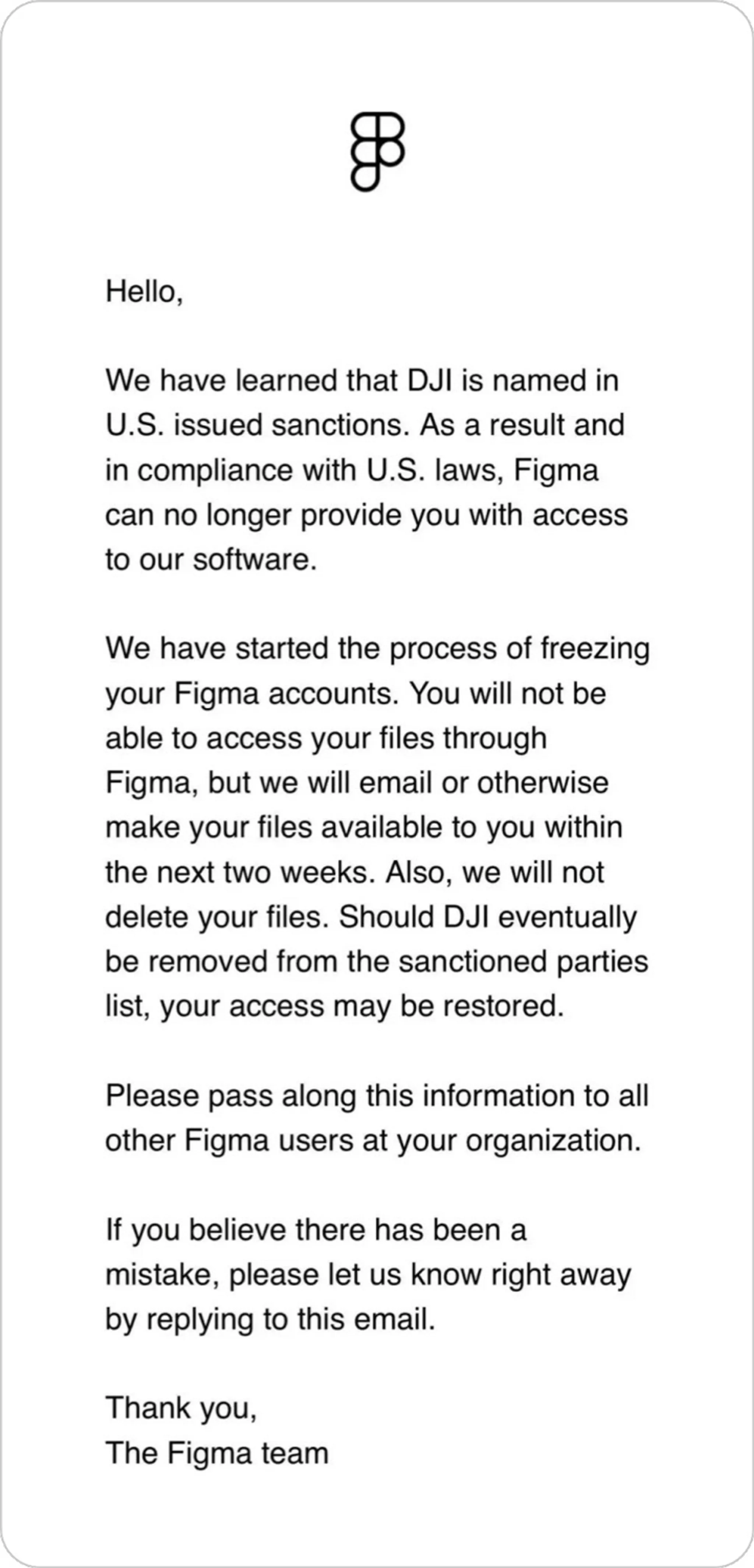
Many major companies in China had already deployed Figma extensively, including ByteDance, Tencent, NetEase, and Ping An Insurance. All of them responded to the issue immediately — for example, ByteDance required all designers to urgently back up their design files as a precaution.
At Alibaba & Ant Group, I had spent the past six months trying to push Figma deployment within the Ant International design team to improve design efficiency. As luck would have it, on the Thursday before the DJI incident, we officially received our first batch of pilot accounts — making us the first team within the group to have completed the entire process of business requirement justification, data security review, procurement compliance review, legal contract signing, and procurement/finance approval.
Unfortunately, after discussions over the weekend, we decided to abandon the Figma procurement and had already formally notified them via email to terminate the process. For the foreseeable future, we would need to continue our design work on Sketch.
Setting DJI Aside — Why Do We Need Updated Tools?
Purely from a design perspective, Figma is an exceptionally excellent design efficiency tool. It not only improves design efficiency but also significantly enhances the workflow of upstream and downstream colleagues, especially developers. Its capabilities are industry-recognized.
In short, the need for new tools stems from the shortcomings of existing ones. Sketch is a very resource-hungry application. Its outdated software architecture means that even after numerous updates, it still can't be called "smooth." In my daily work with colleagues, Sketch crashing seven or eight times a week is quite common. Even now, Sketch's development team hasn't considered PC compatibility, meaning developers must have a Mac with Sketch installed, or use parsing tools.
Another point is that we've entered an era of design collaboration. Whether it's UX and UI collaboration, outsource management, or — as with our international design team — extensive cross-border remote collaboration, today's design work can't be satisfied by simply transferring files or syncing them through shared folders. Design heavily relies on real-time, WYSIWYG collaboration capabilities both internally and externally.
Of course, Figma also makes Design Tokens truly usable and empowers actual development implementation scenarios. If you're not familiar with Design Tokens, our team once gave a presentation:
Design Tool Choices at Alibaba/Ant
Qingyun, Head of the Alibaba Design Committee, commented on the topic of Alibaba designers using Figma at an event:
- D-One, Sketch, and Figma don't necessarily replace each other. Alibaba developing D-One doesn't mean preventing designers from using Figma and other tools;
- Alibaba hopes designers can use advanced tools to work efficiently, produce better results, and contribute to business — we don't reject new tools;
- Designers can boldly, especially as teams, adopt new tools and powerful design instruments;
I was fortunate to attend that event in person and ask questions, and I was very excited. That event solidified my determination to try new tools and improve team efficiency. After returning to Shanghai, I accelerated the Figma procurement process, and despite some bumps, we obtained full approval and received Ant International's first batch of pilot accounts on March 10.
Today, after the DJI incident, with Figma deployment falling through, as we once again find ourselves staring at Sketch's crash screen, shouldn't we, as members of Alibaba's design community, think about what's next for design efficiency tools? Alibaba/Ant has nearly three thousand designers — possibly reaching ten thousand including ecosystem workers — almost certainly a significant 1% of China's design industry. Can we pool resources to incubate domestic design tools within the group? Can the Design Committee or CTO line recognize that "design," the field that seems least related to great-power competition, has also reached the point of being constrained by Americans? And can Alibaba/Ant set an example for Chinese design on this topic, just as it did when bidding for the Olympic torch design?
Industrial-grade software has been designated by the government as a core technology area. While UX/UI design tools may not have a very high technical barrier, the Figma incident shows that even the smallest wrench can make it hard to breathe. I trust that Alibaba/Ant will have plans for this matter, and as a member of the design team, I have certain expectations. And regardless, we can't fall behind Tencent and ByteDance's in-house tools.
Practically Speaking — What About Design Efficiency Now?
After Figma launched in 2015, it was quickly cloned from top to bottom by various domestic software companies. Among the more notable ones:
- MasterGo (incubated by Lanhu)
- Instant Design (即时设计)
- Pixso
I did brief trials of the above tools over the weekend and explored their enterprise capabilities. Commendably, they are all excellent imitators — from UI to functionality, they closely resemble Figma. If migration from Figma is needed, these tools can be picked up very quickly. However, whether their capabilities are fully equivalent to Figma's, and whether collaboration is smooth, requires further detailed verification.
Unfortunately, their enterprise-level capabilities are not yet mature. All three are primarily free for individual use, and none have detailed enterprise subscription pricing and feature specifications on their websites. Teams with such needs would need to investigate further. One advantage over Figma is that domestic companies better understand large enterprise requirements, and all offer private deployment capabilities, better meeting large companies' stringent data security requirements.
Both MasterGo and Instant Design now support importing Figma files. If needed, you can try them. I'll also mention a third-party Figma-to-Sketch plugin for teams that need it — it's a paid plugin starting at $19/month:
In Closing
I believe that after the DJI incident, Figma likely won't be the mainstream choice for China's design industry for some time. But our work must continue, and the industry must keep developing. So if you're also someone passionate about discovering and trying new tools, improving product-development efficiency, and freeing designers' hands, let's connect and chat anytime. If enough people are interested, starting an internal discussion group would be great too.